Introduction
Seeing, as this training is being provided by Loadbalancer.org, we will first dig into the differences between Global Server Load Balancing and local load balancing (sometimes referred to as Server Load Balancing or SLB). Please also understand that this is not generic training about Global Server Load Balancing. This training is specifically targeted at understanding and implementing Global Server Load Balancing on Loadbalancer.org appliances for use cases already identified and approved by Loadbalancer.org.
So, let us first discuss when we use normal load balancing and when we need global server load balancing. The need for local load balancing arises when you have an application or service which has a demand placed upon it that cannot be provided by a single server. Another server is added to perform the same function, effectively doubling the number of requests that can be handled; it is at this point that you should also be adding a load balancer to the solution. The reason behind this is that as soon as you add a secondary server and create a pool of devices providing your service, you introduce a problem. That problem is "how should requests be distributed between the servers?". There are myriad ways to solve this issue, but the best and simplest is to use loadbalancer.org appliances.
The need for Global Server Load Balancing (GSLB) can arise from another myriad of reasons including, but not limited to, the following:
Reduced Latency by sending requests to the closest available servers.
Additional redundancy of a workload that is replicated between multiple data centres
Data Sovereignty for information that must be kept within certain localities and/or geographical boundaries
This graphical representation of a Virtual Service should help to describe the placement of the key elements that have been referred to when discussing local load balancing.
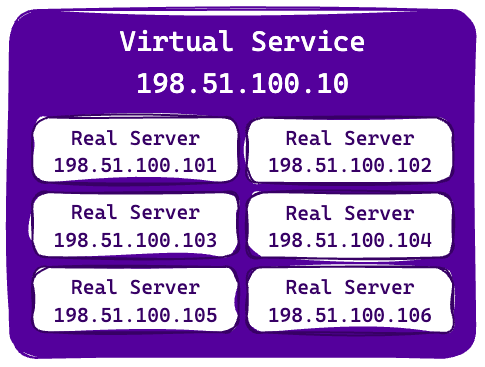
With local load balancing there is a Virtual Service which contains a VIP to receive incoming requests as well as a pool of Real Servers to distribute the requests to.
With that in mind, we can expand the diagram to show the placement of a Virtual Service within a GSLB configuration.
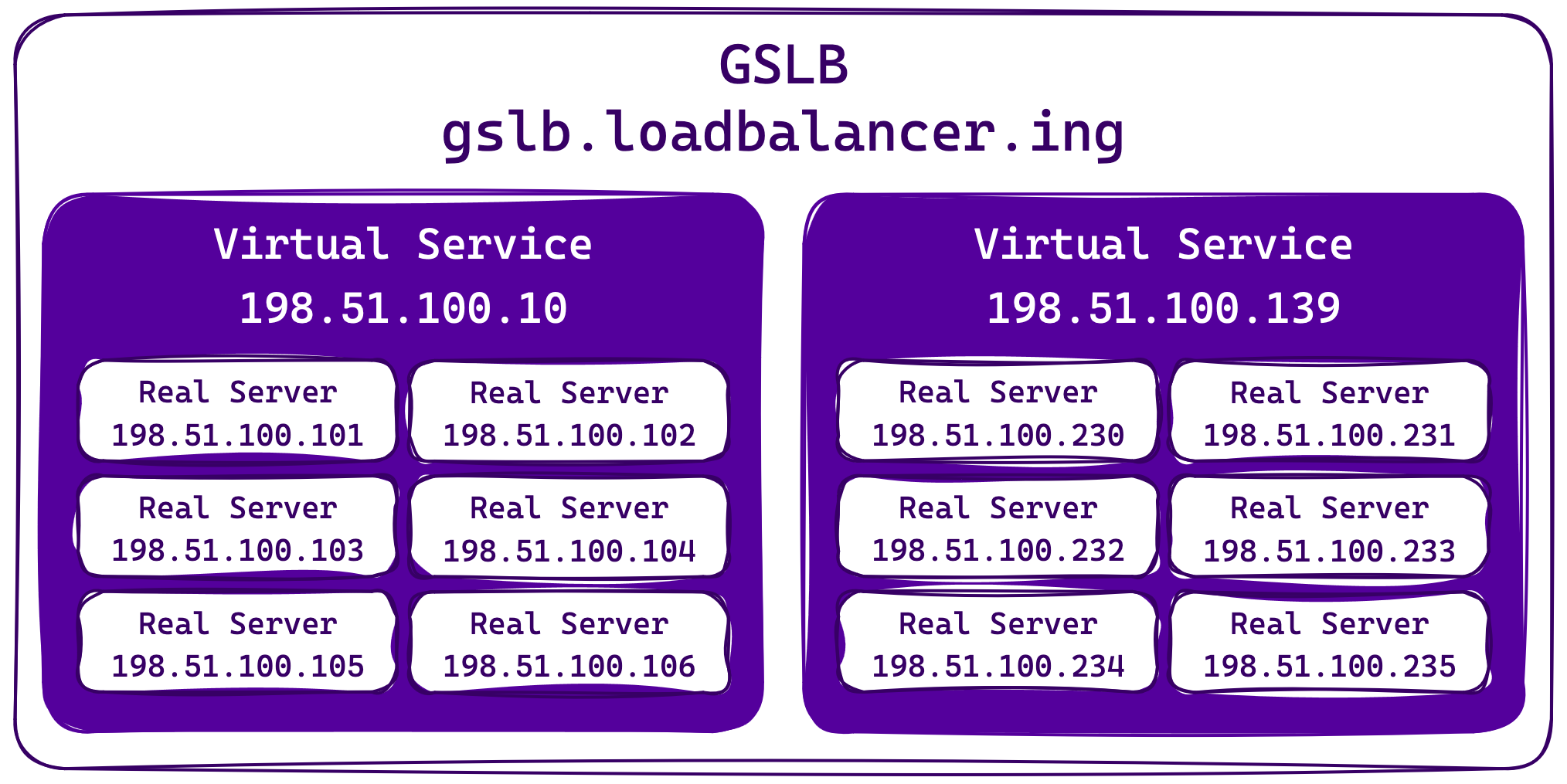
With GSLB the single location that the traffic comes in on is shifted up the stack. GSLB is configured with a global name that serves traffic to multiple VIPs. The VIPs then do their job as usual and distribute the connections on to the pool of real servers.
What this diagram is showing us has already been touched upon in the TL;DR at the top of the page. What GSLB is doing, at it's core, is load balancing virtual services. That is, it is load balancing load balancers.
At this point we shall take a high-level look at what the process of GSLB entails. We will have a look at when GSLB is happening. For the purposes of this material we are going to assume a good working knowledge of load balancing in general as we are going to 'gloss over' massive parts of load balancing. As you will see...
Local Load Balancing
This is a gross over-simplification of the process to illustrate the differences between load balancing and GSLB.
A client sends a connection to the VIP.
The virtual service evaluates the request and sends it to a real server.
Global Server Load Balancing
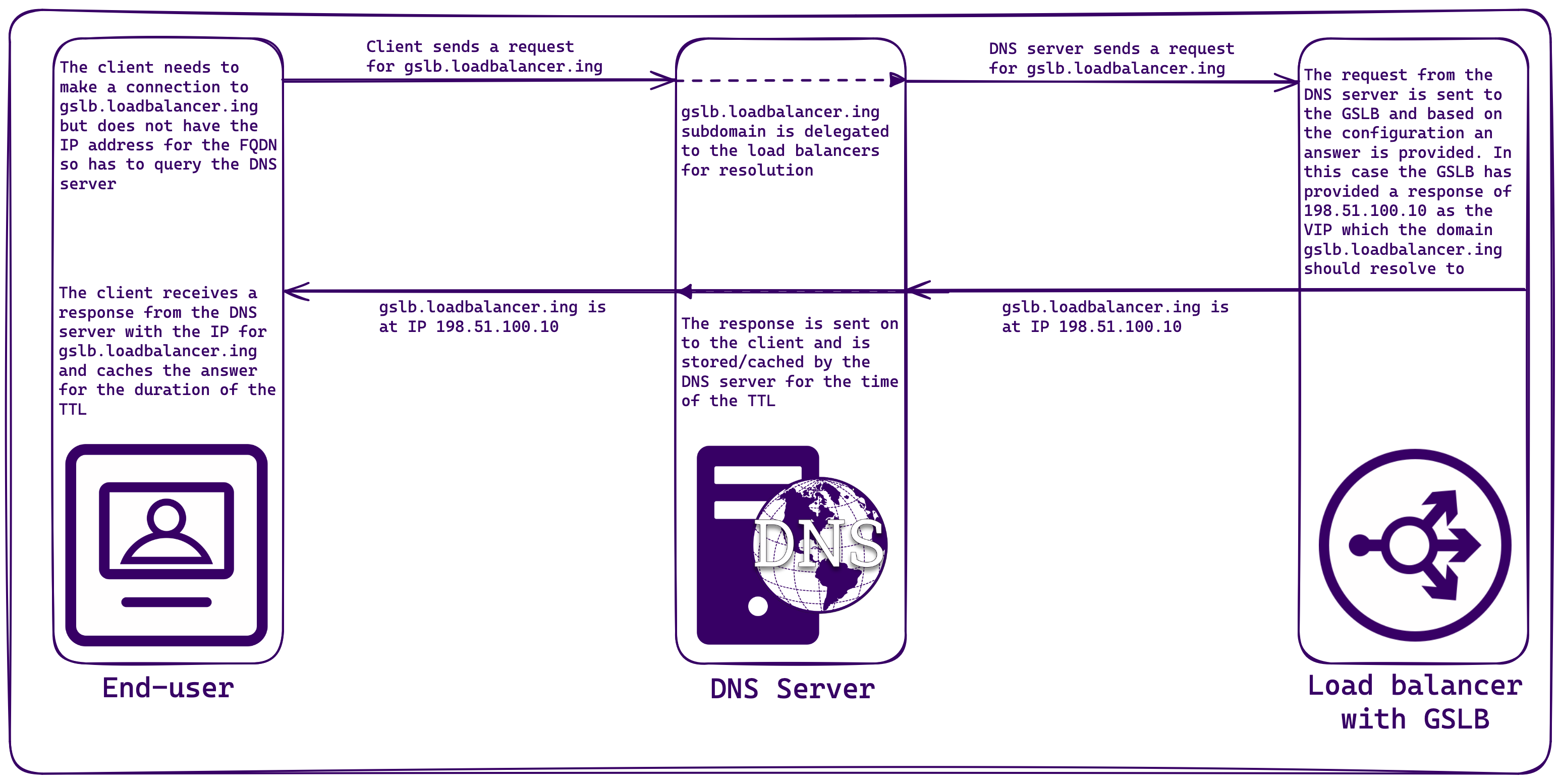
By contrast, GSLB has to perform some DNS processes before it is able to pass the traffic to the correct destination.
Please also refer to the accompanying diagram below.
The client needs to make a connection to gslb.loadbalancer.ing but does not have the IP address for the FQDN so has to query the DNS server.
Client sends a request for gslb.loadbalancer.ing
The gslb.loadbalancer.ing subdomain is delegated to the load balancer(s) for resolution.
The DNS server sends a request for gslb.loadbalancer.ing
the request from the DNS server is sent to the GSLB and based on the configuration, an answer is provided. In this case, the GSLB has provided a response of 198.51.100.10 as the VIP which the domain gslb.loadbalancer.ing should resolve to.
gslb.loadbalancer.ing is at IP 198.51.100.10
The response is sent on to the client and is stored/cached by the DNS server for the time of the TTL.
gslb.loadbalancer.ing is at IP 198.51.100.10
The client receives a response form the DNS server with the address for gslb.loadbalancer.ing and caches the answer for the duration of the TTL.
So, that is the basic description of what the GSLB is and what it is doing.